The Artist in the Garden: Cooper Sanchez and the Living Restoration of Cator Woolford Gardens
March 04, 2026
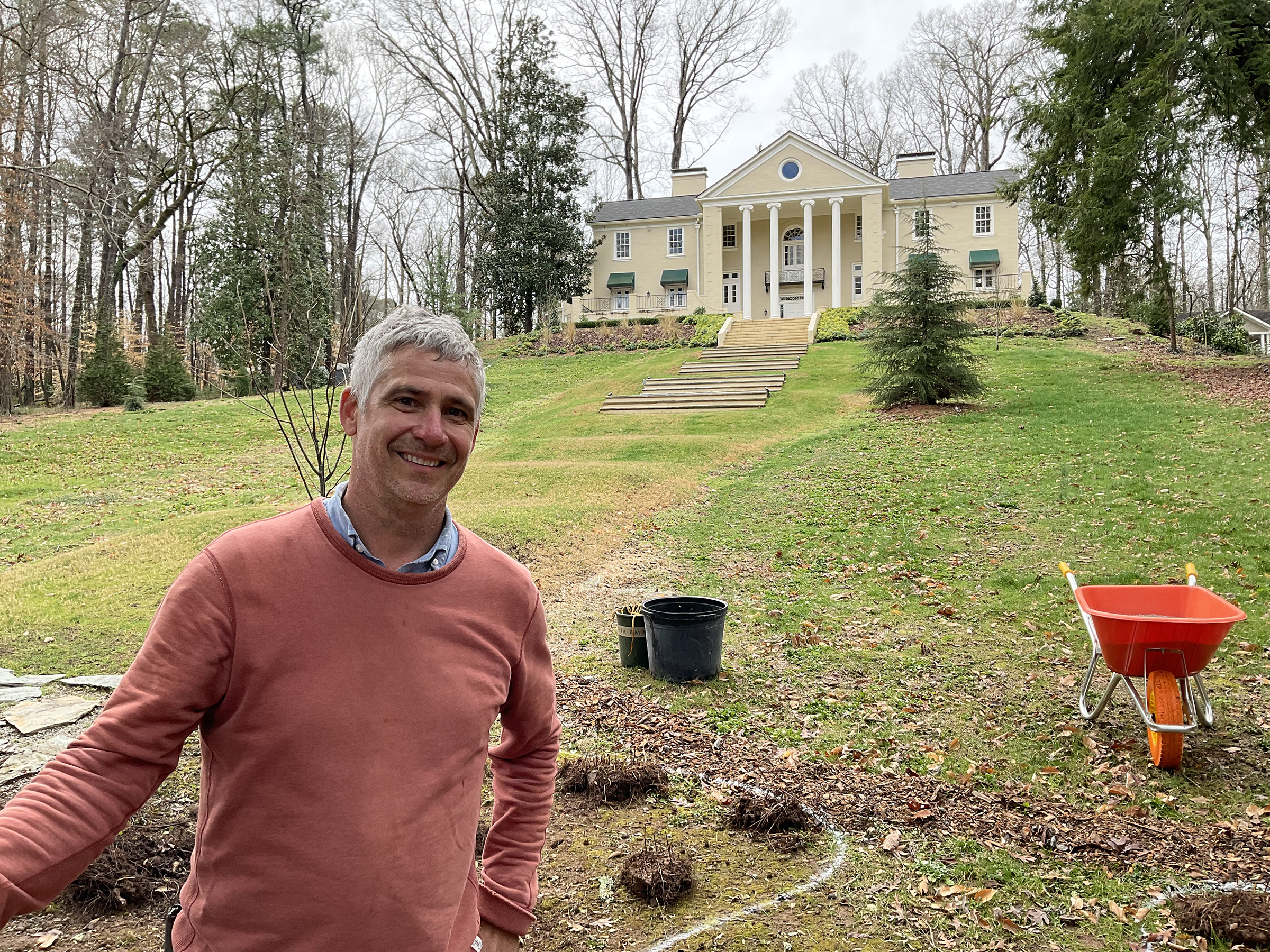
The Artist in the Garden: Cooper Sanchez and the Living Restoration of Cator Woolford Gardens
This story is part of the CWG Journal—a new space where we share the people, history, and purpose behind Cator Woolford Gardens.
If you want to understand Cator Woolford Gardens, you have to understand the person tending it.
On any given week, Cooper Sanchez can be found walking the property—studying the slope of the lawn below the house, assessing a canopy that needs thinning, or planning the next phase of woodland restoration. He moves through the landscape with the focus of someone composing a work of art—because in many ways, he is.
Gardening, for Cooper, is not maintenance. It’s design over time. It’s history layered with instinct. It’s knowing when to remove, when to reveal, and when to let something grow.
And at Cator Woolford Gardens—the historic estate held in trust by the Children’s Rehabilitation Center to support Frazer Center’s mission—that work carries weight.
“This has been the project I’m most proud of,” Cooper says.
A Childhood Among Garden Ruins
Cooper grew up in Rome, Georgia, in a Victorian home with a formal boxwood parterre and a giant bell turned upside down into a fish pond. By the time his family moved in, the garden had already fallen into neglect.
“I grew up around garden ruins,” he says. “My childhood wasn’t indoors behind screens. I was outside.”
He didn’t initially plan to become a gardener. He studied illustration at the School of Visual Arts—first in Savannah, then in New York—enduring long drawing classes and rigorous critique. He built a career in art and design before returning to Atlanta and starting a small landscaping company, partly to support his artwork.
But gardening began to pull at him.
Through Whitespace Gallery owner Susan Bridges, who was representing him at the time, Cooper met Ryan Gainey, one of Atlanta’s most respected gardeners. Working in Ryan’s garden changed everything. Ryan later introduced him to Brooks Garcia, a gifted horticulturist and one of Ryan’s most accomplished mentees.
“They gave me a career,” Cooper says. “Gardening became the way I could bring art and nature together.”
Learning from Masters—and from Loss
Under Ryan and Brooks, Cooper’s education was immersive and informal. He traveled to study gardens in the Cotswolds in England, visited Longwood Gardens and Chanticleer in Pennsylvania, and built a deep personal library of garden history.
He also developed a fascination with Frederick Law Olmsted, whose Linear Park system runs along Ponce de Leon Avenue. Olmsted had designs for this site—including a proposed lake—but those plans were never realized. As Cooper puts it, Cator Woolford Gardens is “sort of the exclamation point” to Olmsted’s Atlanta vision.
Cooper’s first major historic restoration work came at Oakland Cemetery, where he worked alongside Brooks Garcia.
Six months into that project, a tornado struck in March 2008, toppling 95 mature trees in less than a minute.
“We spent the next two years planting hundreds of trees,” Cooper says. “Most of which I’m still maintaining today.”
Oakland taught him scale, patience, and resilience. It also shaped his professional niche: restoring Southern historic gardens.
But at Oakland, he was still working with a mentor.
Cator Woolford Gardens would be the first time he carried that responsibility alone.
The Rock Garden That Reawakened the Property
Cooper’s work at Cator Woolford Gardens began with a nearly forgotten rock garden built by Cator Woolford in the 1920s.
By the time he first saw it, it was choked with invasive growth and debris—more swamp than sanctuary. A grant allowed restoration to begin. Cooper studied historic photos, uncovered original stonework, and worked carefully to restore the intricate water system that once siphoned from Peavine Creek.
When the project was complete, Ryan Gainey visited.
“This is lovely,” Ryan told him. “Why didn’t they call me?”
Cooper laughs at the memory—but he also remembers the pride in Ryan’s voice. Ryan loved this place.
That affirmation mattered.
Reconnecting the House and the Garden
The estate’s layout is defined by elevation.
The house sits high on a hill. A broad lawn slopes downward to the top of an old Italian-style staircase, which descends into the formal garden below—the space where most weddings now take place.
One of Cooper’s primary goals was to strengthen the relationship between house and garden.
A veranda was added to better honor the home’s architectural character and create meaningful outdoor space at the top of the hill. Cooper designed a new set of steps to connect the upper lawn more intentionally to the garden below.
In the early 1990s, Ed Dougherty, a well-known landscape architect, built the hardscapes that define the garden today: columns, pathways, restored bridges. Cooper echoed and complemented that structure by adding column-like conifers. Arbor hoops now line either side of the central lawn, their shapes reminiscent of arched church windows, giving the ceremony space a sense of reverence without rigidity.
But this restoration has not been about recreating 1924.
Photography from that era is limited. The property has evolved. Tennis courts once occupied much of the lawn during Cator Woolford’s tenure. The house itself has endured fire and change. Rather than strict preservation, Cooper describes the work as “contemporary problem-solving within historic bones.”
Over the past five years, he and the CRC board have worked collaboratively to prioritize improvements—restoring pathways, rebuilding stonework, refining planting plans, and addressing infrastructure.
A young holly hedge now lines the berm along Ponce de Leon Avenue. It will take a few years to mature, but eventually it will create a living green border that softens the presence of traffic and frames the garden more completely.
In the coming seasons, Cooper hopes to focus more deeply on the woodlands—removing invasive species and reintroducing ferns, bulbs, and ephemerals that once defined the property’s quieter edges.
“It’s always evolving,” he says. “I move plants the way most people move furniture. The garden teaches you.”
Work Rooted in Purpose
Every event at Cator Woolford Gardens directly supports Frazer Center’s mission of advancing inclusion for children and adults with disabilities. For Cooper, that connection is not abstract. It’s personal.
Nearly fifteen years ago, his brother Michael, who has Down syndrome, came to live with him. The two now share a home they bought together, and Michael is “the best uncle in the world” to Cooper’s daughter, Birdie. Michael doesn’t share Cooper’s love of gardening, but when he’s not working at Publix, he helps keep the household running. With extended family living next door, their life is full, active, and closely connected.
“Historic gardens don’t always mean a lot to people,” Cooper says. “But it’s a joy to work for a place that is working to create a more inclusive world for people with disabilities. This place is a treasure.”
Still an Artist
Though gardening has become his primary medium, Cooper continues to draw most mornings. He scales up small drawings and screenprints them onto tarps. He founded Illumine, an annual springtime art installation at Oakland Cemetery that continues today. He also co-founded a small-batch sauce company with his partner, Olive. Lemon Pig began as a creative experiment and now has a loyal local following, with bottles available at Candler Park Market and the DeKalb Farmers Market.
But Cator Woolford Gardens stands apart.
“This is the first project where I’ve been able to take everything my mentors taught me and apply it independently at this scale,” he says.
Walk the gardens today and you’ll see beauty everywhere—structure against sky, botanical columns mirroring a colonnade, woodland edges slowly returning to health.
What you may not immediately see are the decades of study, mentorship, risk, and resilience that shaped it.
This garden is not finished.
Gardens rarely are.
But under Cooper Sanchez’s care, Cator Woolford Gardens continues to grow—not just as a wedding venue, not just as a historic landscape, but as a living space rooted in purpose.